
Introduction
Perpetual futures have become a dominant instrument in modern trading, particularly in cryptocurrency markets. Their rise has been driven by accessibility, deep liquidity, and the ability to trade with leverage without the constraints of contract expiration.
At a surface level, perpetual futures appear to be a simple evolution of traditional futures contracts—offering continuous exposure without the need to roll positions.
However, this perception is misleading.
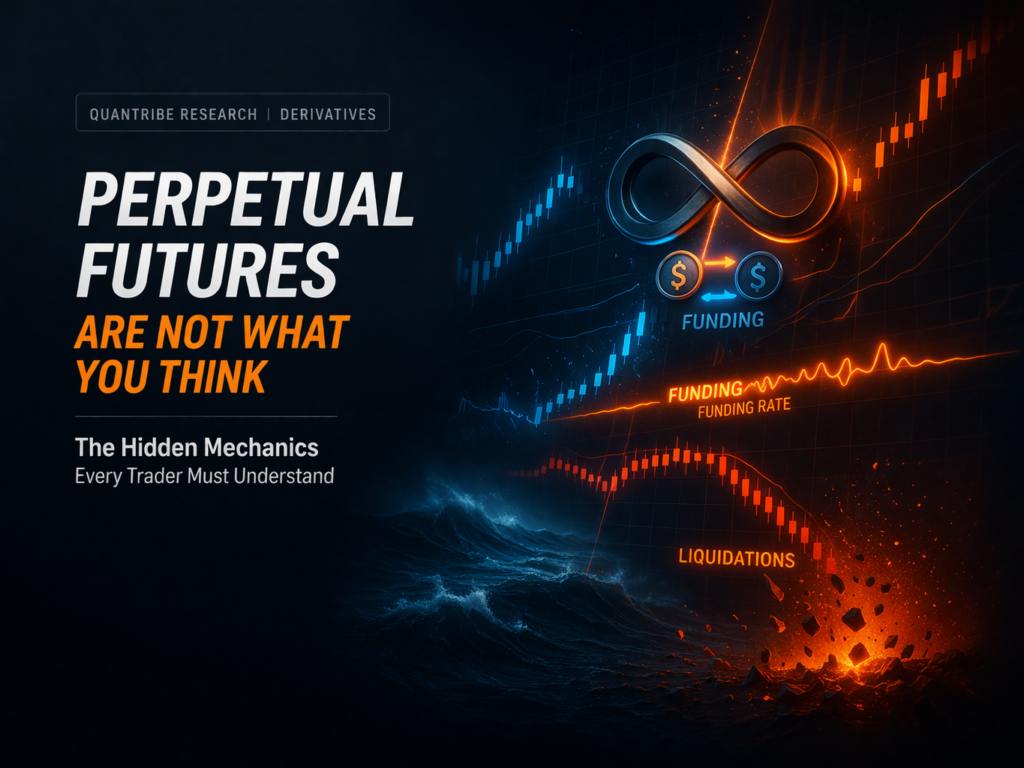
Perpetual futures are not merely “futures without expiry.” They represent a fundamentally different market structure—one that is driven not only by price, but by internal mechanics such as funding flows, leverage, and trader positioning.
Understanding these dynamics is essential for anyone seeking to trade them effectively.
Structural Difference from Traditional Futures
Traditional futures contracts, such as those traded on CME Group, are defined by a fixed expiration date. Their pricing reflects a combination of:
- Spot price
- Interest rates
- Carry costs
- Market expectations
These contracts periodically settle, forcing participants to close or roll positions. This process naturally resets positioning and prevents long-term structural imbalances from accumulating.
Perpetual futures, by contrast, eliminate expiration entirely. Positions can, in theory, be held indefinitely. Instead of converging to spot through settlement, they rely on an internal balancing mechanism: the funding rate.
This distinction fundamentally alters how these markets behave.
The Role of Funding Rates
The funding rate is the core mechanism that anchors perpetual futures to the underlying spot market.
At regular intervals, traders exchange payments:
- When perpetual prices trade above spot, long positions pay short positions
- When perpetual prices trade below spot, short positions pay long positions
While often perceived as a minor adjustment, funding plays a central role in shaping market dynamics.
Over time, it acts as a continuous transfer of capital between participants, incentivizing traders to take the opposite side of crowded positioning.
In strongly trending markets, funding rates can remain persistently positive or negative, creating sustained pressure on one side of the market.
P&L Is Not Driven by Price Alone
A key misconception among traders is that profitability depends primarily on correctly predicting price direction.
In perpetual futures, this assumption does not always hold.
For example, during sustained bullish conditions:
- Funding rates are typically positive
- Long positions incur repeated costs
- These payments accumulate regardless of price movement
As a result, a trader can be directionally correct yet experience diminished—or even negative—returns due to funding outflows.
This introduces an additional dimension to trading performance: cost of positioning over time.
A Market Dominated by Positioning
Unlike traditional futures markets, where macroeconomic factors and hedging flows play a significant role, perpetual futures are more directly influenced by trader positioning.
Key variables include:
- Open interest
- Funding rates
- Liquidation thresholds
These elements interact to create a market where price movements are often driven by imbalances in leverage, rather than purely by new information.
When positioning becomes crowded:
- Funding rates increase
- Margins become thinner
- The market becomes structurally fragile
In such conditions, relatively small price moves can trigger disproportionately large reactions.
The Liquidation Mechanism
One of the defining features of perpetual futures markets is the presence of automated liquidation systems.
Because traders frequently use high leverage, exchanges enforce strict margin requirements. When these are breached:
- Positions are forcibly closed
- Market orders are executed automatically
- These executions impact price directly
This process can lead to cascading effects:
- Liquidations push price further in the same direction
- Additional positions are triggered
- Volatility accelerates
These feedback loops are a primary driver of sharp spikes and rapid reversals commonly observed in perpetual futures markets.
Absence of a Natural Reset
In traditional futures markets, expiration cycles act as a structural reset:
- Positions are closed or rolled
- Open interest is redistributed
- Market imbalances are reduced
Perpetual futures lack this mechanism.
As a result:
- Positioning can accumulate over extended periods
- Imbalances can grow without constraint
- The eventual unwind can be significantly more severe
This structural persistence contributes to the formation of large-scale squeezes and volatility events.
Implications for Traders
The differences outlined above have important implications.
Trading perpetual futures is not equivalent to trading spot or traditional futures. It requires a different framework—one that accounts for:
- Funding dynamics
- Leverage distribution
- Market positioning
Ignoring these factors can lead to systematic disadvantages, even when directional views are correct.
Effective participation in these markets depends on recognizing that:
- Price is only one component of returns
- Costs and flows are equally important
- Market structure can dominate short-term behavior
Conclusion
Perpetual futures have introduced a new paradigm in trading—one that blends continuous exposure with embedded leverage and real-time capital flows.
They are efficient and flexible instruments, but also structurally complex.
Their behavior is shaped less by traditional valuation models and more by internal feedback mechanisms, including funding, positioning, and liquidation dynamics.
For traders, this means that success is not solely a function of predicting price movements.
It depends on understanding the system itself.
Perpetual futures are not simply a variation of existing instruments—they are a distinct environment, with their own rules, risks, and opportunities.
Recognizing this distinction is the first step toward navigating them effectively.