
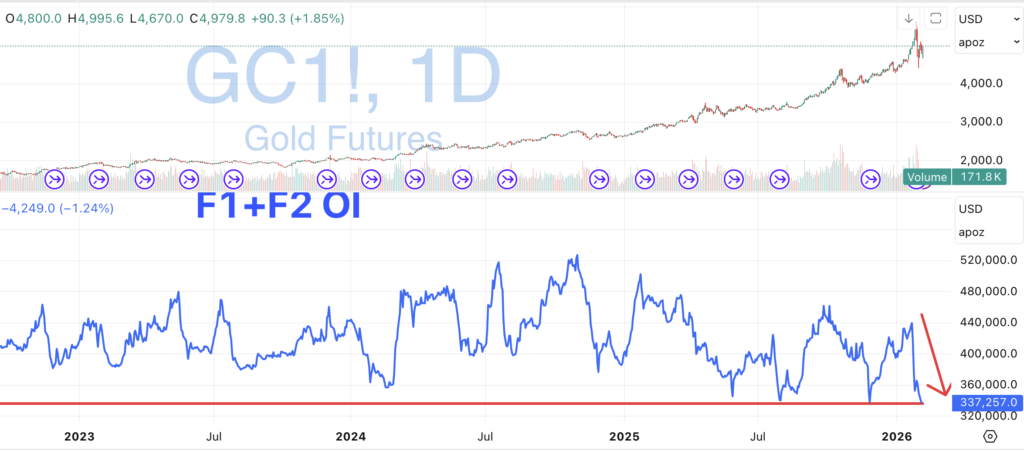
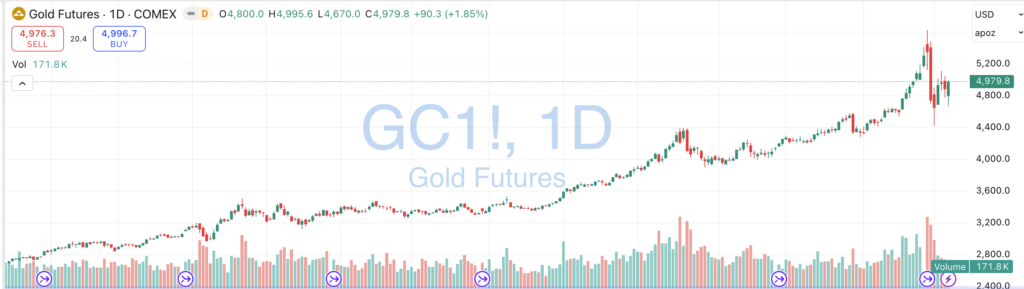
Gold futures experienced extreme price action recently. After an exceptional rally in 2025 – with prices nearly doubling — the market saw a sharp and violent move lower, leaving gold roughly 10% below its all-time high.
At first glance, this looks like a dramatic correction. But price alone rarely tells the full story. To understand what is really happening beneath the surface, we need to look at Open Interest and volatility.
A year of strong performance, followed by instability
The 2025 rally in gold was powerful and persistent. Trend-following systems, discretionary traders, and macro-driven allocations all benefited from the move.
However, markets that move fast and far tend to accumulate leverage. When conditions change – even slightly – that leverage becomes unstable.
The recent price action did not unwind slowly. It happened fast, with wide daily ranges and elevated volatility.
Volatility signals stress, not direction
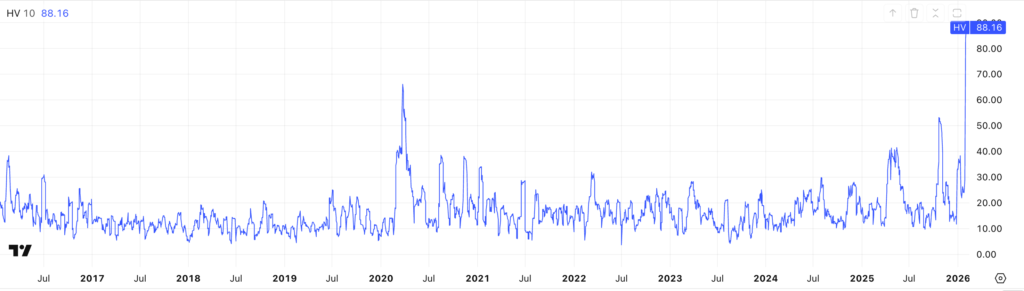
Volatility on gold futures surged to levels not seen in several years. This is an important contextual signal.
High volatility after a long trend usually means:
- Forced position adjustments
- Risk models reducing exposure
- A disagreement among market participants about fair value
Volatility alone does not tell us where price is going next – but it does tell us that the previous regime has ended.
Open Interest: the key signal
The most important signal in the current environment comes from Open Interest.
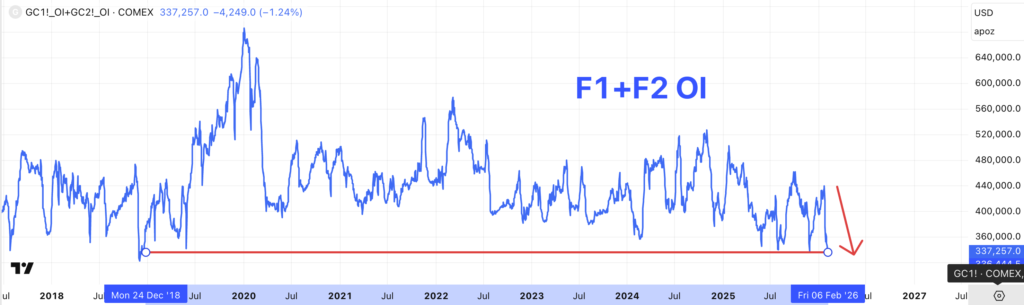
During the recent violent price moves, open interest dropped sharply, reaching levels not seen for several years.
This matters a lot.
Open interest represents the number of outstanding futures contracts. When it falls rapidly, it means:
- Existing positions are being closed
- Leverage is being removed
- Participation is shrinking, not expanding
This is very different from a scenario where price falls while open interest rises — which would indicate aggressive new bearish positioning.
Here, the market is not building conviction. It is cleaning up.
What falling open interest usually implies
Historically, the combination of:
- High volatility
- Falling open interest
- A strong prior trend
tends to mark a transition phase, not an immediate trend reversal.
These phases are often characterized by:
- Choppy or sideways price action
- Reduced effectiveness of trend-following strategies
- Gradual stabilization as weaker hands exit
In simple terms, the market is asking:
“Who actually wants to hold gold here, without leverage?”
What to watch next
Rather than predicting direction, it is more useful to watch structural signals:
- Does open interest stabilize, or continue to fall?
- Does volatility start to compress?
- Do price declines occur without further OI liquidation?
Only after stabilization tends to come a new directional move.
Final thoughts
The recent move in gold futures looks less like a structural trend reversal and more like a deleveraging event after an exceptional rally. Until volatility cools and open interest finds a stable floor, the market is likely in a re-pricing and consolidation phase, not a clean trending regime. Understanding this distinction helps avoid forcing directional trades in an environment that is fundamentally about positioning reset, not conviction.
Disclaimer: This analysis is for educational purposes only and does not constitute investment or trading advice.